
Firewall & network security
WatchGuard and Sophos firewalls with intrusion prevention, content filtering and VPN. Network segmentation, so that one infected computer does not take the whole company down with it.
Cybersecurity for SMEs
Firewall, endpoint protection, verified backups and an emergency plan that has actually been tested. We set up IT security so that it does not get in the way day to day and still works in an emergency. We look after the IT security of small and medium-sized businesses in Cologne and the surrounding area – from the firewall and verified backups to the emergency plan. When something happens, we can reach you quickly from our base in Köln-Bilderstöckchen.
The situation
The most common misconception among SMEs is: “We’re too small to be of interest.” The exact opposite is true. Modern attacks are automated. They scan the internet for open access points, outdated systems and weak passwords – without checking how big the company behind them is. If you are reachable, you will be attacked.
The damage rarely comes from the encryption itself, but from what follows: days without your ERP system, without email, without access to customer data. On top of that come reporting obligations under the GDPR, questions from your cyber insurer and customers who want to know whether their data has been affected.
So we approach it from the other side: not “How do we keep everyone out?” but “What happens if someone does get in – and how quickly can we get back to work?”
Services in detail
Security is not a product you buy once. We combine technical measures, ongoing monitoring and organisational rules into a concept that fits the size of your business.
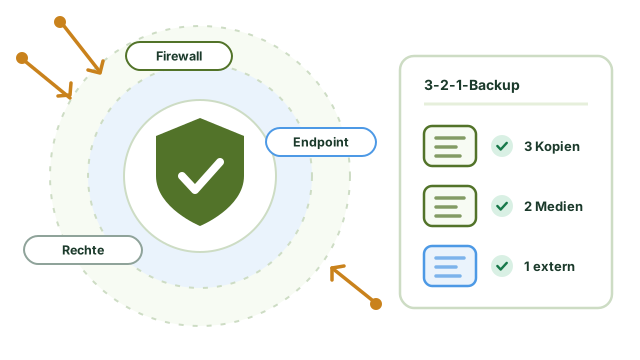
WatchGuard and Sophos firewalls with intrusion prevention, content filtering and VPN. Network segmentation, so that one infected computer does not take the whole company down with it.
Modern protection on every workstation and server – based not only on signatures but on behaviour. Suspicious encryption activity is stopped before it spreads.
A backup concept based on the 3-2-1 rule with Veeam, Acronis or Synology: three copies, two media, one off-site. With regular test restores instead of blind trust.
A recovery plan that has been rehearsed, with defined targets for recovery time and maximum data loss. We know beforehand how long it will take – not only when disaster strikes.
Spam and phishing filters, attachment scanning, SPF, DKIM and DMARC setup. So that forged senders can no longer send invoices to your customers in your name.
Training for your staff using realistic examples, multi-factor authentication, password management and a permissions concept based on the principle of least privilege.
Ransomware
A ransomware attack costs small and medium-sized businesses several days of downtime on average. What determines how long is not the technology but the preparation. These six points decide whether you are back at work the next morning or lose a week.
NIS2
The EU NIS2 Directive considerably widens the range of companies with cybersecurity obligations. Many businesses are not directly covered – but have the requirements passed on to them by their clients. Three questions clarify where you stand.
What counts is sector and size. Covered sectors include energy, transport, health, water, digital infrastructure, IT services, postal services, waste, chemicals, food and manufacturing – in each case from 50 employees or €10 million annual turnover.
This is the more common case. Companies that are covered must take their suppliers' security into account and pass the requirements on by contract. If you work for such a client as a supplier, service provider or trades business, you will receive questionnaires and contract clauses.
Requirements include risk management, incident handling with reporting channels, emergency and backup concepts, supply chain security, access control with multi-factor sign-in, and training. Management is personally liable for implementation.
To be honest: most of what NIS2 requires is good IT practice – verified backups, multi-factor sign-in, up-to-date systems, controlled access, an emergency plan. If you already do all that, the main task is to document what you do. That, not the technology, is where SMEs most often fall short.
In one conversation, we tell you whether NIS2 applies to you and, if so, which three things to tackle first. No scaremongering, and without turning it into a project you don't need.
How we work
We don't start by selling technology but with an honest assessment of where you stand.
We check the firewall, backups, endpoint protection, permissions, patch level and external attack surface. You receive a clear report with prioritised findings.
Not everything has to be fixed at once. We rank by likelihood and potential damage and tell you plainly what needs doing this week and what can wait until later this year.
Set up technical measures, rebuild backups, clean up permissions, write the emergency plan. In agreed time windows, without interrupting your business.
Ongoing monitoring, monthly backup tests, regular patch level reviews – and an emergency plan that is rehearsed at least once a year.
Our audit tool
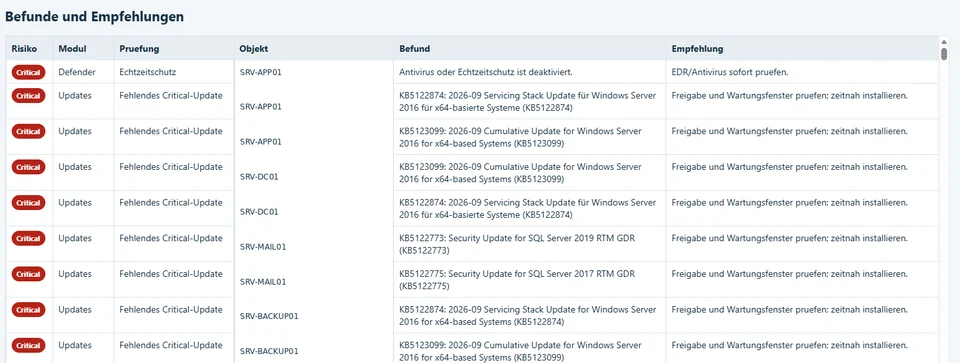
We don't carry out the security check with a checklist in our heads but with our own software. Security Audit Pro reads out the Windows environment – clients and servers, Active Directory, Exchange, updates, Defender, network and backup – and assigns every finding to a risk level, a module, a check and an object. We built the tool ourselves; it is now in its sixteenth version.
The benefit is repeatability. Two audits of the same network reach the same result – even if six months lie between them and a different colleague carries them out. What you get at the end is not a collection of observations but a list sorted by urgency, with technical evidence and a recommendation for each item.
The audit is read-only: nothing is changed, and nothing is installed that stays behind afterwards. See all views of the tool at a glance.
Why INFONET
Enterprise solutions fail in SMEs not because of the technology but because nobody is there to run them. We build what you can actually sustain day to day.
Free IT security check
In around 60 minutes, we check the key points of your security posture and tell you where your three biggest risks lie. On site or remote, free of charge and without obligation.
Frequently asked questions
Both are necessary, but not sufficient on their own. A conventional virus scanner recognises what is already known; modern attacks deliberately use new or legitimate tools. What also matters: verified backups outside the network, multi-factor authentication, up-to-date systems, a permissions concept and security-aware staff. These are exactly the points we check in the security check.
Three copies of your data, stored on two different types of media, with one copy off-site. In addition, we use immutable backups that cannot be deleted or encrypted even with stolen admin rights. That is the most effective single protection against ransomware.
The NIS2 Directive directly covers mainly larger companies in certain sectors. Many smaller businesses are affected indirectly, however, because clients pass the requirements down their supply chain by contract. We look at your specific situation and implement the measures in a way you can demonstrate to clients and auditors.
That depends almost entirely on preparation, not on the attack. With verified, immutable backups and a documented sequence, we usually get the core systems back within one working day and the complete environment within a few days. Without that preparation, we are talking about one to two weeks – and about which data is lost for good.
That is why we work out this time with you in advance rather than finding it out in an emergency.
With 30 employees you are, as a rule, not directly covered – the threshold is 50 employees or €10 million annual turnover in one of the sectors listed. It can still affect you indirectly: companies that are covered share responsibility for the security of their supply chain and pass the requirements on to their service providers and suppliers.
So if you work for a hospital, an energy supplier or a larger industrial company, the questionnaires will come. We check this with you in one conversation and put the result in writing – which in itself is an answer you can show your client.
Call us. What matters then is the right order: isolate the affected systems rather than restarting them straight away, secure the evidence, contain the damage and only then restore in a controlled way. In parallel, reporting obligations under the GDPR and towards your cyber insurer need to be checked. We guide you through this process and take care of the technical side.
We check critical systems every month with a test restore, and at least once a year we run through a complete recovery. That is the only way to know your actual recovery time. A backup that has never been restored is an assumption – not protection.
Yes. The vast majority of successful attacks begin with an email that someone opened. We run practical awareness sessions using real examples from your industry – short, easy to follow and without finger-wagging. On request, we add simulated phishing campaigns to measure the effect.
With a firewall you pay for two things, and the second is regularly forgotten: the device and the licence for the security features. Without a valid licence, a firewall keeps working but no longer receives new signatures or security updates – it then becomes a risk itself.
The price depends on throughput, number of users and the features you need. A business with fifteen workstations and one line needs a different device from one with two sites and thirty home workers connecting via VPN.
Make sure every quote includes: the device, the licence for the planned term, setup, rule set maintenance and manufacturer support for replacement if the device fails.
Not a single product but a chain. Antivirus alone is not enough, because modern ransomware attacks don't arrive as a known file but through stolen credentials and vulnerabilities that nobody knows about yet.
What actually protects you: separate permissions, so that a compromised account cannot work its way through the entire organisation. Two-factor sign-in. Prompt updates. Detection of unusual behaviour rather than just known malware. And a backup that cannot be deleted from the affected system.
That last point decides the outcome of an emergency. Everything before it reduces the likelihood – the immutable backup determines whether you are back at work in two days or in two weeks.
The ransom is rarely the biggest item. More expensive are the downtime, the recovery, the reporting obligations towards authorities and customers, legal support and the loss of trust among clients.
Work out what a day without working IT costs your business – wages, lost orders, contractual penalties. That figure is the honest yardstick for what prevention may be worth.
Day-to-day operations, monitoring and support – the foundation that security needs in order to work at all.
Learn moreServers, network and cloud set up with segmentation and resilience built in from the start.
Learn moreData protection, record of processing activities and technical and organisational measures.
Learn moreMulti-factor sign-in, phishing protection and a backup that does not depend on Microsoft.
Learn moreClients
Whether for a one-off assignment or a long-standing partnership: when precision and reliability matter in IT, well-known names from retail, aviation, industry, medical technology, logistics and the events sector rely on our expertise. A selection from our client list:

REWE

Lufthansa Systems

RTL

Circus Roncalli

Fluke

Tektronix

Ewals Cargo Care

emeis Fachklinik Bensberg

pfm medical

Guett-Dern

Hans Jungblut

Intercom

Von Borries & Partner

TUNA FOOD

Morawitzky
Further reading
Detailed answers and real projects from our work – free and without registration.
Guide
Passkeys are becoming mandatory – the four dates and what to do now.
ReadCase study
How an open permissions structure comes about and how to close it.
ReadGuide
What a backup really has to deliver.
ReadGuide
A restore test you can carry out in two hours.
ReadGuide
A three-step check – with an applicability tool.
ReadGuide
Six signs that always apply – and what to do after a click.
ReadFree initial consultation
Most companies only find out when disaster strikes. We find out beforehand – in a free security check.
+49 221 984300-0Switchboard and support hotline
[email protected]Reply within 4 hours on working days
Robert-Perthel-Straße 7250739 Köln – Bilderstöckchen
Mon–Fri 9 am–6 pmEmergency support outside these hours by arrangement
This website works without cookies, without tracking and without advertising networks. For one optional feature we embed content from an external provider. Doing so transfers your IP address to that provider – which only happens if you allow it.