
3CX phone system
Setup, configuration and operation of 3CX – either as a hosted cloud instance or on a server on your premises. Including licensing and version updates.
3CX · VoIP · Unified communications
Modern VoIP telephony with 3CX: as a cloud system or on your own premises. With home office connection, call queues, a mobile app and integration with your CRM – at costs that are usually well below those of traditional phone systems.
The background
The end of traditional ISDN lines in Germany forced many companies to switch. Most simply replaced the old system with something similar – a phone system in the comms room, fixed phones on fixed desks, no connection to the home office or mobile devices.
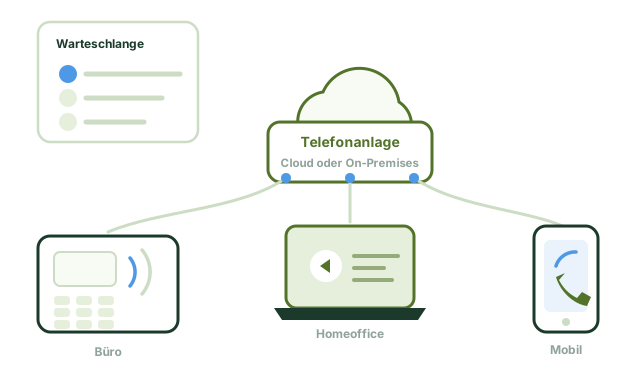
Modern VoIP telephony can do a great deal more. An employee working from home can be reached on their normal direct extension. Calls can be distributed by time of day, queue or skills. Callers are recognised in the CRM before the phone is even picked up. And in many cases the phone system costs less than the old maintenance contract.
We rely on 3CX for this – a solution that can run either in the cloud or on your own server, works with common SIP providers and does not require proprietary hardware.
Our services in detail
From replacing your old phone system to a full call centre solution with multiple queues and reporting.
Setup, configuration and operation of 3CX – either as a hosted cloud instance or on a server on your premises. Including licensing and version updates.
No hardware in the comms room, no maintenance, a monthly price. Particularly suitable for distributed teams, multiple sites and companies without their own server room.
Call distribution by availability or skills, call queues with position announcements, a call-back option and reports on waiting times and service levels.
Yealink desk phones, DECT systems for warehouses and workshops, conference phones for meeting rooms and headsets for heavy phone users – selected according to how they will be used.
SIP trunk selection, number porting, prioritisation of voice traffic on the network (QoS) and VPN connections between sites – so that the call quality is right.
Integration with Microsoft 365, Outlook and common CRM and ERP systems: caller identification, click-to-dial, automatic call notes and presence status.
Reasons
A phone system is rarely replaced out of enthusiasm. Usually one of these six reasons tips the balance.
The manufacturer has discontinued the product line, spare parts come second-hand, and there are no more security updates. The system keeps running – until the day a component fails and no replacement can be found.
What was meant as a stopgap in 2020 is everyday life today. Anyone who is reachable at home on their private number, or has to be diverted, is working around the phone system – and when they leave, customer contacts leave with them.
Nobody knows how many calls go unanswered, how long callers wait or when the load is at its highest. Without these figures, you can neither plan staffing nor justify why another person is needed.
The switch to IP-based lines was completed long ago. If you are still working with adapters, you are running a stopgap solution that becomes more expensive with every fault than replacing it properly.
Two systems in two places mean double maintenance, separate numbering plans and internal calls over the public network. One system for both sites is almost always cheaper and always simpler.
Old contracts with a base fee per channel, per-minute rates from another era, maintenance contracts for technology that is hardly used any more. For many businesses, the switch pays for itself from the savings.
How we work
The switch can be planned. What matters is number porting and preparing the network – we take care of both in advance.
How many extensions, how many simultaneous calls, which call queues, who works on the move or from home? This determines licensing and sizing.
We measure bandwidth and latency, check the cabling and set up prioritisation of voice traffic. The most common cause of poor call quality lies in the network, not in the phone system.
The new system is set up and tested in parallel. We schedule the number porting with the provider for a fixed date – usually with a switchover of just a few minutes.
A short introduction for your staff, adjustment of announcements and schedules, then ongoing operation with version updates and changes on request.
Choosing a system
Eight points that actually make a difference in everyday use. Much else may be on the data sheet, but never gets used.
Why INFONET
There are many phone systems. We have settled on 3CX for practical reasons.
Is your phone system still on an old contract?
Many companies pay more for maintenance contracts on old phone systems than a modern cloud phone system would cost in total. We will work out the comparison for you, without obligation.
The critical day
The biggest worry before changing phone systems is always the same: that on the day of the switchover nobody can get through. That worry is justified – porting the numbers is the only step that cannot simply be repeated at will.
That is why, with us, the new system runs in parallel beforehand. It is set up, configured and tested with a test number while the old one keeps working. Only when everything is in place are the numbers ported – the actual switch then usually takes a few minutes.
Frequently asked questions
Yes. Existing numbers and entire number blocks are ported. We agree the date with the outgoing and the incoming provider and plan the switchover so that, as a rule, it only takes a few minutes and falls outside your main business hours.
The cloud version needs less maintenance, requires no hardware on site and is particularly suitable for distributed teams and multiple sites. A system on your own premises can make sense if there are special requirements regarding data storage, interfaces or integration with existing systems. As 3CX supports both modes of operation, you can switch later.
Yes, and that is one of the biggest advantages. Your employees can be reached on the same extension as in the office – via the 3CX app on their smartphone, a softphone on their laptop or a desk phone at home. Calls can be transferred internally as if everyone were sitting in the same building.
Not necessarily. Many existing SIP-capable devices can continue to be used. Older ISDN or analogue phones do not work directly, but some can be connected via adapters. We check your existing equipment and tell you what can stay. We mainly source new devices from Yealink.
With a properly designed network it is better than with traditional telephony, because modern wideband codecs are used. The prerequisites are sufficient bandwidth, low latency and prioritisation of voice traffic (QoS) on the network. That is exactly what we check and set up before the switchover – it is the most common cause of quality problems.
Yes. 3CX offers integrations with common CRM and ERP systems as well as with Microsoft 365 and Outlook. As the phone rings, your employees can already see who is calling and which matters are open, and they can dial directly from the customer record. For special cases, the integration can be custom-developed via interfaces.
That depends on four things: the number of extensions, whether the system is on your premises or runs as a cloud service, which handsets you use and which additional features you need – call queues, recording, CRM integration.
Broadly, there are two models: with a system on your own premises, you pay once for the system, licences and setup, and then on an ongoing basis for maintenance and call charges. With a cloud system there is no purchase, but you pay monthly per extension. Calculated over five years, the two are often closer together than they seem at first glance.
Handsets are the item most often missing from quotes. Always include them – with thirty workstations, they make a considerable difference.
Buying makes sense if you run a server room anyway, want to use the system for a long time and value keeping everything in-house. Renting makes sense with multiple sites, a lot of work on the move and if you do not want to run your own hardware.
One point that is often overlooked: with a cloud system, telephony stops if the internet line fails. If you depend on it, you need a second line – and that belongs in the cost comparison.
Often, yes. SIP-capable devices from common manufacturers can usually be taken over. Older ISDN or proprietary system phones cannot – they are tied to their particular phone system.
We check this before making a quote, based on the model names. It is worth it: if half the devices can stay, that changes the calculation considerably.
From placing the order to the switchover, allow four to eight weeks. The longest item is not the technology but porting the numbers – the outgoing provider has statutory deadlines for this that nobody can shorten.
The new system is set up in parallel and does not disrupt your operations. With proper preparation, the actual switchover takes a few minutes.
Then telephony stops – with any IP-based system, regardless of manufacturer. That is why a fallback is part of the setup: in the event of an outage, incoming calls are automatically diverted to mobile numbers so that customers can still reach someone.
For businesses where telephony is business-critical, we also set up a second line, in the simplest case via mobile data. These costs belong in the calculation from the start.
Technically, yes. Legally, it is a sensitive matter: in Germany, recording a conversation without both parties' knowledge is a criminal offence under Section 201 of the German Criminal Code (§ 201 StGB). It only becomes permissible with consent – in practice through an announcement at the start of the call and the option to object.
In addition, there are the works council's (Betriebsrat) co-determination rights and retention periods under the GDPR. We set up the technology; you should agree the legal details with a law firm.
Not necessarily. 3CX runs on a small server on your premises, on an existing virtualisation platform or as a hosted system in a data centre. All three are common.
The decision depends less on the technology than on whether you run a server room anyway and how good your internet connection is. With only one site and a good line, the hosted system is usually the simpler solution.
This is the part that is regularly forgotten in quotes and then noticed on the day of the switchover. Door intercoms, lift emergency phones, alarm systems with telephone diallers and fax machines are often still connected to analogue ports on the old system.
There is a solution for most cases – adapters, IP-capable retrofits or replacement. What matters is that these devices are recorded before the quote, not afterwards. We go through the list during the assessment.
With a system on your own premises, call data does not leave your building. With a hosted system, it depends on the data centre – we use locations in Germany and put this in writing in the contract.
The telephony provider through which calls go out to the public network is a separate matter. There, too, you can choose a provider based in Germany. For law and tax firms and medical practices, this regularly comes up in audits.
Network, switching and QoS – the foundation for stable call quality.
Learn moreTelephony and IT managed by one provider: one number, no questions about who is responsible.
Learn moreCustom interfaces between your phone system, CRM and line-of-business applications.
Learn moreClients
Whether a targeted one-off assignment or a partnership lasting many years: when precision and reliability matter in IT, well-known names from retail, aviation, industry, medical technology, logistics and the events sector rely on our expertise. A selection from our list of references:

REWE

Lufthansa Systems

RTL

Circus Roncalli

Fluke

Tektronix

Ewals Cargo Care

emeis Fachklinik Bensberg

pfm medical

Guett-Dern

Hans Jungblut

Intercom

Von Borries & Partner

TUNA FOOD

Morawitzky
Further reading
Detailed answers and real projects from our work – free and without registration.
Free initial consultation
Send us your current bill and the number of extensions. We will work out, without obligation, what a modern 3CX solution would cost you.
+49 221 984300-0Switchboard and support hotline
[email protected]Reply within 4 hours on working days
Robert-Perthel-Straße 7250739 Köln – Bilderstöckchen
Mon–Fri 9 am–6 pmEmergency support outside these hours by arrangement
This website works without cookies, without tracking and without advertising networks. For one optional feature we embed content from an external provider. Doing so transfers your IP address to that provider – which only happens if you allow it.