
Custom software
Business applications for processes that no off-the-shelf software covers: order management, costing, inspection reports, resource planning – built around the way you work.
Custom software · Apps · Interfaces
Custom applications, mobile apps, web portals and interfaces between systems that weren't designed to talk to each other. Developed by a team that already knows your IT landscape.
When custom development makes sense
Standard solutions are almost always the first choice – they are proven, cheaper and continue to be developed. But there are situations where they fall short: when a process is your real competitive advantage, when two systems need to exchange data and no ready-made interface exists, or when a standard solution only fits 60 per cent and the remaining 40 per cent are bridged with Excel and email.
This is exactly where we develop. Usually not as a completely new system, but as a targeted addition: a portal for your customers, an app for your field staff, an interface that removes duplicate data entry, or a report that brings together figures from three systems.
The advantage of having us do it: we already run your infrastructure. We know where the data is, how the permissions are set and what the network can handle.
Services in detail
From a single interface to a complete business application – with the aim that the solution can still be maintained five years from now.
Business applications for processes that no off-the-shelf software covers: order management, costing, inspection reports, resource planning – built around the way you work.
Customer portals, staff areas, booking and approval systems. Usable in the browser, with no installation, with permission management and connections to your existing systems.
Mobile applications for iOS and Android – for field staff, warehouse, service or customers. They can also work offline when there is no connection on site.
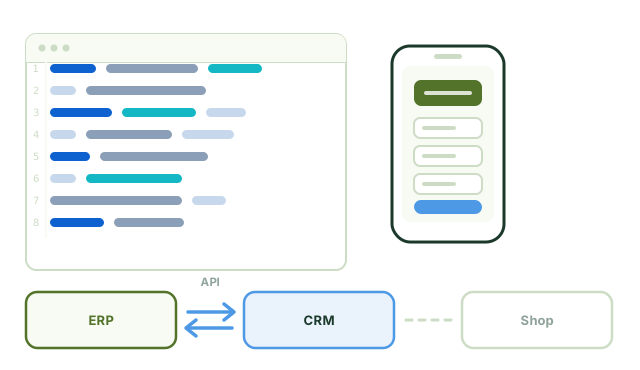
Connecting ERP, CRM, inventory management, online shop, phone system and accounting. So that data is entered once and used everywhere.
Key figures from several systems brought together and presented clearly – automatically, instead of being compiled by hand in Excel every month.
Automating recurring manual tasks: extracting data from documents, classifying data, preparing cases. Where it makes sense, with AI-assisted methods too.
Go to the AI sectionFrom practice
It is rarely about building a system from scratch. Usually there is one particular sticking point – and it costs time every week.
An order is entered in the shop, then transferred by hand into the inventory management system, then again into accounting. Every transfer takes time and creates errors that someone has to track down later.
The report the Managing Director needs every month is put together in an Excel file by one person. If that person is off, there are no figures.
Where is my delivery? What is the status? Could you send me the invoice again? A portal answers these questions around the clock and takes the load off your sales team.
Industry software from 2012 whose vendor no longer exists. It runs, but nobody can change it, and it keeps the business stuck on an old version of Windows.
E-invoicing, GoBD-compliant filing (GoBD: German principles for proper electronic bookkeeping), documentation obligations under NIS2. The standard software can't do it, or won't for another two years – but it has to be working before then.
Copying lists together, renaming files, forwarding emails, building reports. Unremarkable individually, but together they add up to half a full-time position.
How we work
In manageable steps, with working interim versions, and without ending up with something other than what was agreed.
We look at the process, talk to the users and check whether a standard solution might be cheaper after all. The result is a specification with an effort estimate.
Before development starts, we create a clickable mock-up of the user interface. That way you see early on how the application feels – at this stage, changes cost almost nothing.
We deliver working interim versions for testing at short intervals. You see the progress and can adjust priorities along the way.
Testing with real data, user training, go-live, and after that maintenance, bug fixing and further development as needed.
Technology
The biggest risk with custom software is not the development, but what comes afterwards. We have often enough taken over applications that were technically impressive and that nobody could touch after three years – because the framework used was no longer maintained, or because only the original developer understood how it was built.
That is why we deliberately choose conservatively: proven databases, widely used programming languages, as few third-party libraries as possible. Five years from now, someone other than us should still be able to develop the application further.
From our own development
If you commission software, you want to know what you will end up with. Remaxia manages rental properties, Casenda is business software for construction and trades businesses, SubBaseApp is construction site software for civil engineering, Gastella is catering software for caterers and party services, Kuvert is banqueting software for event venues and Aliefa is association software for animal welfare organisations. All six were created in-house – not commissioned by a single client, but as our own products, which we maintain ourselves.
They show how we work: in-depth domain knowledge, a conservative technical approach, and the data where the client wants it. All six are described in detail on the products page.
From our own development
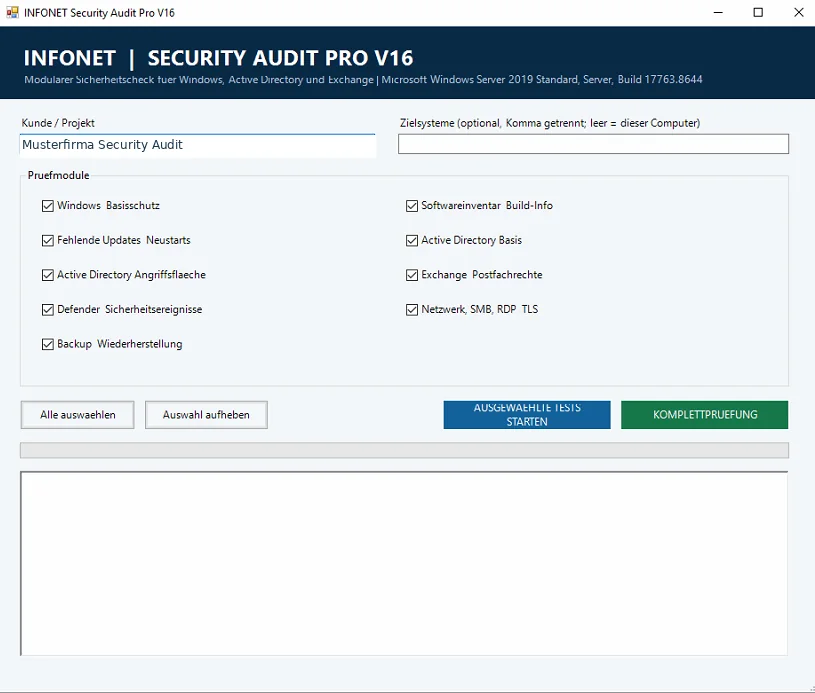
Not everything we create is a product for sale. Security Audit Pro is an audit tool we wrote for our own security checks: it reads out a Windows environment – clients and servers, Active Directory, Exchange, updates, Defender, network and backup – and generates a report in which every finding has a risk level, a check item, an affected object and a recommendation. It is now in its sixteenth version.
We mention it here because it shows how we develop when nobody is watching: a clearly defined purpose, a result that still makes sense a year later, and sixteen versions, each of which came out of a real audit where something was missing. That is exactly how we work on your application.
You can see it at Security Audit Pro; we use it in our IT security audit.
Why INFONET
The difference from a pure software agency: we factor in operation, security and data storage from the outset.
Assess first, then develop
In a free preliminary conversation, we clarify whether custom development is the right route at all. In roughly one case in three we recommend a standard solution – and tell you which one.
New since September 2026
Since 11 September 2026, the reporting obligations of the EU Cyber Resilience Act have applied; from December 2027, the full requirements for products with digital elements apply. This affects everyone who makes software – including us. That is why we deliver what you will need later right from the start. What exactly applies from when, and who is affected, is explained in detail in our guide to the Cyber Resilience Act – with a check to see whether you are affected and a calculator for the reporting deadlines.
To be honest
For us, a development project is a contract – for you, it is a commitment lasting years. That is why in these four cases we decline or suggest something else.
Frequently asked questions
That depends entirely on the scope. An interface between two systems is often in the low four figures (euros), a complete business application with permission management, user interface and reports considerably more. After the preliminary conversation and the specification, you receive a reliable estimate, and for clearly defined projects a fixed price.
Yes. For custom-developed software, you receive the rights of use to the source code as well as the technical documentation. This means you are not tied to us and could hand over further development to another provider at any time.
Yes, both native and cross-platform. Which approach makes sense depends on the purpose: apps that make heavy use of device features such as the camera, GPS or offline storage we tend to develop natively; information-focused applications often cross-platform – which halves the effort.
In the vast majority of cases, yes. Modern ERP, CRM and inventory management systems provide interfaces. If no documented interface exists, there are usually other ways – via database access, file exchange or automated exports. We check this in advance, before we draw up a quote.
You usually see a first clickable prototype after two to four weeks. A smaller application goes live in eight to twelve weeks; larger projects run over several months. Because we deliver in stages, you can often use parts of the functionality before everything is finished.
Yes. Maintenance, bug fixing, adaptation to new requirements and updating of core components are part of what we offer. For this we either agree an ongoing maintenance contract or bill on a time-and-materials basis – depending on how critical the application is for your business.
Yes. This is currently one of the most common reasons clients come to us. It usually involves two directions: automatically reading in incoming invoices in XRechnung or ZUGFeRD format and passing them to accounting – and generating outgoing invoices from your inventory management system in the required format.
Check first whether your existing software can now do this itself. Often it is a question of the module or version, and then going through the vendor is cheaper than custom development.
A fair question for an owner-managed company. Three safeguards: the source code belongs to you and is handed over to you, not just kept by us. The documentation is written so that an outside developer can work with it. And we deliberately use widespread technology rather than niche solutions for which there are no specialists.
If you wish, we can also agree to deposit the source code with a third party (source code escrow).
Both, depending on how the project is structured. A clearly defined interface can be offered at a fixed price. For an application whose requirements will still become clearer along the way, a fixed price is false precision – it is either calculated with a large mark-up or leads to change requests.
Our usual approach: a fixed price for the concept phase, followed by a reliable estimate for implementation. After the concept phase, you can step out without any obligation and take the results with you.
You decide. We run applications on your own server on your premises, in a data centre in Germany or in your existing cloud environment.
For businesses with special requirements regarding where their data stays – law and tax firms, medical practices, suppliers with documentation obligations – running it on your own premises is often the simpler route, because a whole range of questions about data processing on your behalf (and the data processing agreement that goes with it) no longer arise.
Yes, and we deliberately build things so that this is possible. You receive the source code, the documentation and the access credentials. We will also actively hand over to a successor if you want to switch.
That is not a favour but self-interest: a client who stays because they can't leave is not a satisfied client.
We use language models where they reliably help – for example in analysing free text, suggesting categories or searching large document collections. What we don't do is build them into places where a wrong result would go unnoticed.
An important question here is where your data goes. For businesses with sensitive content, we look into running a model on your own premises – slower and less capable than the big providers, but the data never leaves the building.
Everything on this – AI chat on your own server, agents with an MCP server, document recognition and the introduction of Microsoft 365 Copilot – is on our Artificial Intelligence page.
Clarify beforehand whether custom development makes economic sense – and what the alternatives are.
Learn moreServers, databases and cloud environment on which your application runs reliably.
Learn moreSecure data storage, permissions and backups for custom-developed systems.
Learn moreClients
Whether a targeted one-off assignment or a partnership lasting many years: when precision and reliability matter in IT, well-known names from retail, aviation, industry, medical technology, logistics and the events sector rely on our expertise. An extract from our list of references:

REWE

Lufthansa Systems

RTL

Circus Roncalli

Fluke

Tektronix

Ewals Cargo Care

emeis Fachklinik Bensberg

pfm medical

Guett-Dern

Hans Jungblut

Intercom

Von Borries & Partner

TUNA FOOD

Morawitzky
Further reading
Detailed answers and real projects from our work – free of charge, no registration.
Case study
A deadline that could not be moved – and what that means for how a project is scoped.
ReadService
AI chat on your own server, agents, document recognition and Copilot rollout.
ReadGuide
What has applied to manufacturers since 11 September – with a deadline calculator.
ReadGuide
Where language models help – and where they do harm.
ReadGuide
Seven questions that need answering before you choose a system.
ReadFree initial consultation
Tell us briefly where in your business data is entered twice, transferred by hand or bridged with Excel. We will tell you whether a solution is worth it.
+49 221 984300-0Switchboard and support hotline
[email protected]Reply within 4 hours on working days
Robert-Perthel-Straße 7250739 Köln – Bilderstöckchen
Mon–Fri 9 am–6 pmEmergency support outside these hours by arrangement
This website works without cookies, without tracking and without advertising networks. For one optional feature we embed content from an external provider. Doing so transfers your IP address to that provider – which only happens if you allow it.